
Ask a family with three residences who owns the insurance renewal on the lake house, and you'll often hear three different names. That gap, far more than any lack of effort, is where most household breakdowns begin.
A family office concierge standard operating procedure closes it. The document defines what the concierge function covers, how requests arrive, who approves spending, which vendors meet the standard, how the team handles private details, and when a task counts as finished.
We see the same pattern with nearly every family we meet. Capable people surround them, yet the principal still confirms bookings at 10 p.m. and repeats the same instructions every spring. A well-run family office concierge puts structure behind that daily load and returns time and control to the family.
Anyone who has worked with a good coach will recognize the idea. A clear framework frees you to focus on what matters, and an SOP does the same thing for a household.
TL;DR Quick Answers
Family Office Concierge
A family office concierge is an ongoing service that runs a family's household and lifestyle logistics with the same approvals, records, and follow-through a family office applies to its finances. Its purpose is to give the family back time and control.
What it covers: Bill pay with defined approvals, oversight across multiple residences, vendor coordination, travel, and special projects.
How it differs from a personal concierge: A personal concierge handles one-off errands. A family office concierge works continuously and ties into the family's financial administration.
What makes it work: A written SOP that sets scope, intake, approval tiers, vendor vetting, privacy rules, and closeout.
Who it serves: Families with several residences, a steady volume of vendors and invoices, and a strong need for discretion.
What it doesn't do: Replace existing staff or advisors. It coordinates them so everyone works from the same plan.
Top Takeaways
A written SOP turns concierge help into a service the family can count on.
Scope, intake, approvals, vendors, and privacy are the sections you can't skip.
Approval tiers keep control with the family while routine work keeps moving.
Vendor vetting closes one of the most common security gaps in family offices.
Quarterly reviews keep the SOP accurate as residences and staff change.
Why a Family Office Concierge Needs a Written SOP
Service that lives in one person's head leaves with that person. A sick day or a resignation is all it takes for follow-up to slip and for the family to start managing details again. Writing the process down is how good service survives turnover.
Here is what changes once the SOP is in place:
Coordination: The family stops chasing vendors. One team owns each request until it's closed.
Controls: Approvals follow defined tiers and spending limits instead of whoever happens to pick up the phone.
Continuity: A trained team member can step in and run the same process tomorrow.
Visibility: Details live in one place, not across text threads, inboxes, and paper invoices.
The 10 Core Components of a Family Office Concierge SOP
A complete family office concierge SOP covers ten areas. Some take a paragraph. Others, like approvals and vendor standards, deserve a page of their own.
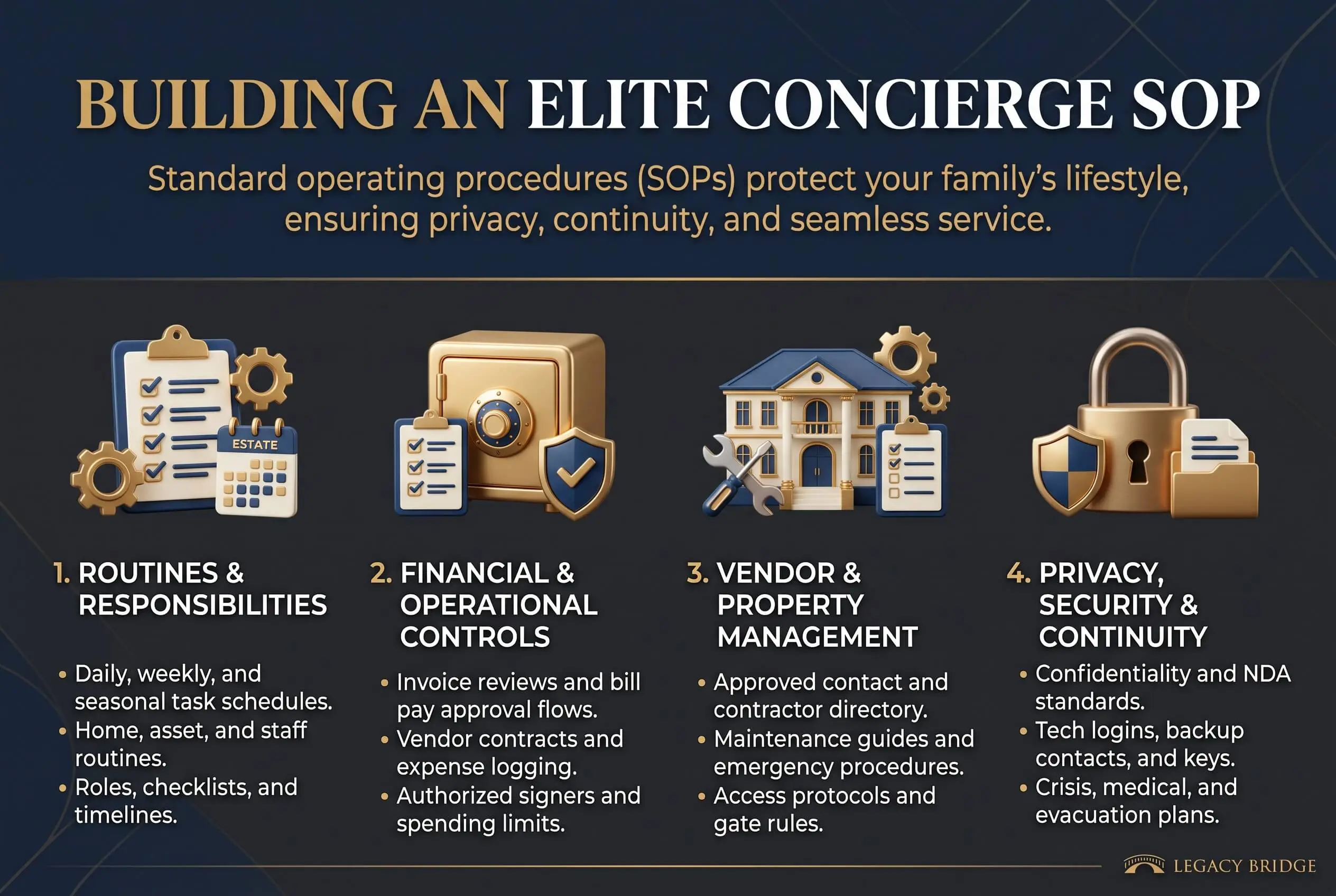
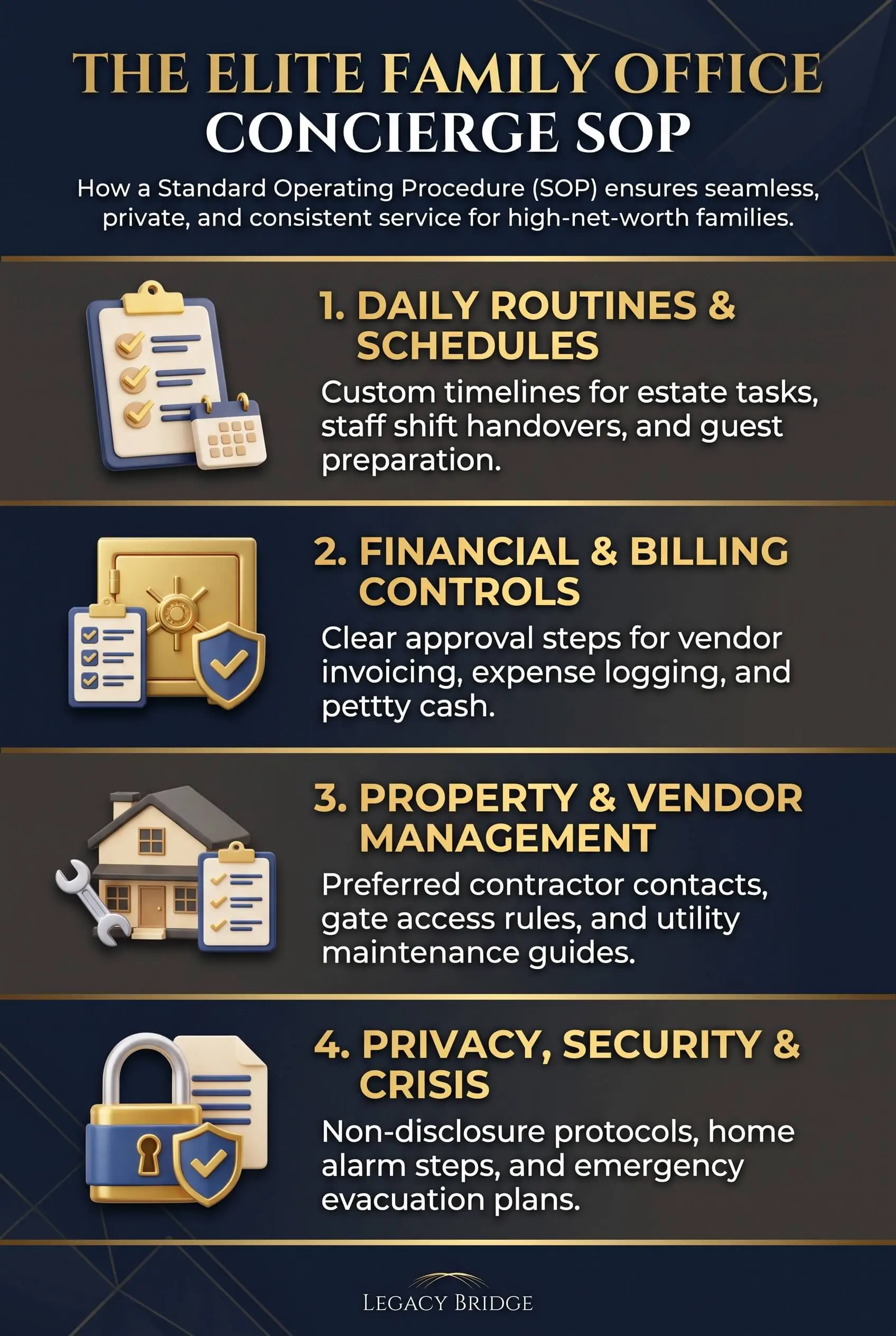
Purpose and scope. Spell out what the concierge handles, such as residences, household logistics, travel, and lifestyle projects. Then name what goes elsewhere, like document administration or investment questions for your advisors.
Roles and authority. List who can submit requests, who approves them, who carries them out, and who speaks for the principal when the principal is unavailable.
Request intake standard. Use one channel and one intake template. Capture the requester, deadline, budget, preferences, and any confidentiality notes. If no one logs a request, assume someone will miss it.
Triage and prioritization. Sort each request as urgent, scheduled, or project work so response times stay predictable.
Approval tiers and spending limits. Decide what the concierge can approve alone and what needs a family member or financial lead. The examples below are a starting point, not an industry rule.
Vendor vetting and management. Ask for proof of insurance, references, and a signed confidentiality agreement before anyone starts work. Review each vendor at least once a year.
Privacy, security, and confidentiality. Share access codes, itineraries, and financial details only with people who need them, and only through secure channels.
Documentation and records. Keep every quote, contract, confirmation, and cancellation term in one system, so anyone can answer "where does this stand?" in a few minutes.
Communication and escalation. Set response-time expectations, an after-hours contact, and clear triggers for bringing an issue to the principal.
Review, KPIs, and continuity. Revisit the document quarterly. Track on-time completion and budget variance, and cross-train so no single person becomes the only one who knows how something works.
Illustrative approval examples
Routine household bills: The concierge pays recurring, pre-approved payees. A new payee or an unusual amount goes to the family or financial lead first.
Vendor engagement: Vetted vendors working within budget need no extra sign-off. New vendors and long-term contracts do.
Travel and events: Bookings that match agreed preferences move ahead. Changes to dates, guests, or budget go to the family for approval.
Projects and purchases: The concierge gathers research and quotes, and a family member signs any commitment.
Sample Workflows Every Concierge SOP Should Map
Start with the workflows that repeat, carry financial exposure, or involve more than one residence.
Bill pay with controls: The concierge matches each invoice to the approved payee list, routes it to the right approval tier, pays it, and files it with its documentation.
Seasonal residence opening and closing: On a set date, the concierge opens the checklist, schedules vendors, confirms each system works, and records the sign-off.
Insurance stewardship: The team tracks renewal dates 90 days out and reviews coverage with your advisors before anyone signs.
Renovation or project oversight: The concierge vets vendors, tracks contracts, reports on milestones, and documents the final walkthrough.
Travel coordination: The team captures preferences once, confirms bookings, shares itineraries through secure channels, and logs every change.
Whatever the request, it moves through the same path: intake, triage, approval, execution, confirmation, and closeout. This structured approach supports trusted nonprofit accounting by ensuring financial requests are properly documented, reviewed, and tracked.
How to Build and Maintain Your SOP
Most families already have the raw material for an SOP. It just lives in email threads and in a few people's memories.
Map priorities and routines. List recurring tasks, key vendors, residences, preferences, and how approvals happen today.
Put controls and workflows in place. Set permissions, intake templates, documentation rules, and communication standards.
Run requests through it. Coordinate, execute, and track every action item to closeout.
Refine on a schedule. Revisit the document each quarter and any time a residence, staff member, or major vendor changes.
"When we sit down with a family that runs two or three residences, the problems they describe rarely trace back to effort and almost always trace back to handoffs, like a renewal nobody owned or a contractor who never signed a confidentiality agreement. We've learned that discretion and control grow out of process far more than personality. The families who write that process down are the ones who get their evenings back."
7 Essential Resources
Family Office (Wikipedia): A plain overview of what family offices do and where concierge support sits among their services.
Standard Operating Procedure (Wikipedia): Why organizations write down routine tasks, and why consistency follows when they do.
Operating Model, Processes, and Controls (Umbrex): A family office playbook chapter on building processes and controls that don't depend on any one person's memory.
Family Office Concierge Services: What They Include and How to Run Them Well (FundCount): Practical guidance on scope, request flow, and tracking vendor commitments.
Family Office Personal Concierge Guide (Select Advisors Institute): Useful for deciding between in-house and outsourced concierge, and for setting approval tiers.
Family Office Cybersecurity Report (Deloitte Private): Research showing where family offices are exposed, including their vendor relationships.
Cybersecurity Framework 2.0 (NIST): The federal standard for managing cyber risk, and a solid reference when you draft your SOP's privacy section.
These resources provide practical guidance on building consistent processes, managing concierge responsibilities, and strengthening privacy and security controls. For families using multi-family office services, documented procedures, clear approval workflows, and reliable vendor oversight help maintain accountability and continuity across household operations.
3 Statistics
More families are formalizing their offices. Deloitte estimated 8,030 single family offices worldwide in 2024 and projects more than 10,720 by 2030. (Deloitte)
Our take: as offices grow more structured, informal concierge help that depends on whoever is free stands out as the weak link.
Cyberattacks are already common. 43% of family offices globally reported a cyberattack in the prior 12 to 24 months. (Deloitte Private)
Our take: concierge teams hold the itineraries, gate codes, and invoices attackers look for, so privacy rules belong in the written SOP.
Vendor controls lag behind. 68% of family offices have not adopted "know your vendor" protocols. (Deloitte Family Office Cybersecurity Report 2024)
Our take: nearly all concierge work runs through outside vendors. In our experience, a vetting and confidentiality standard is one of the most valuable pages an SOP can hold.
Final Thoughts and Opinion
A family office concierge without a written SOP runs on favors, and favors hold up only until the one person who knows everything takes a week off.
Talent matters. Still, the families we've seen get the most from concierge support are the ones who wrote down how the work gets done, then reviewed that document often enough to keep it accurate.
Keep the document short enough to use every day. A ten-page SOP the team actually opens will serve a family better than a binder on a shelf. Start with approvals and vendors, since that's where we see the most risk, and build out from there. Include recurring responsibilities like private school tuition payments and enrollment deadlines to keep important family obligations organized.
Frequently Asked Questions
What is a family office concierge?
A family office concierge is an ongoing lifestyle management function. It handles household logistics, residence oversight, travel, bill pay, and special projects, with defined approvals and documentation. Unlike an errand service, it works alongside the family's financial administration and existing advisors.
What should a family office concierge SOP include?
A family office concierge SOP should cover scope, roles and authority, request intake, triage, approval tiers and spending limits, vendor vetting, privacy rules, documentation, escalation paths, and a review schedule. Approvals and vendor standards usually need the most detail.
How often should a concierge SOP be updated?
Review it every quarter. Update it right away when the family buys or sells a residence, changes key staff, or brings on a major new vendor. A short, current document beats a long, outdated one.
Should a family office run concierge in-house or outsource it?
In-house concierge suits families with constant, highly personal needs and strict privacy requirements. outsourced family office executive services or hybrid support suits families who want professional standards without building a team. In both cases, one SOP should govern scope, approvals, and records.
What is the difference between concierge and administrative support?
Concierge covers lifestyle logistics and household operations, including residences, vendors, travel, and bill pay. Administrative support covers document infrastructure and coordination with the family's professional advisors. Your SOP should draw that line so requests reach the right team the first time.
How does a concierge SOP protect family privacy?
It limits sensitive details to the people who need them, requires vendors to sign confidentiality agreements, keeps information on secure channels, and records who received what and when.
Ready to Put a Process Behind Your Household?
If vendors, invoices, and residences have quietly become a second job, Legacy Bridge can take that work on with defined approvals, careful records, and steady follow-through. Learn how our family office concierge services work and how our broader family office services can support your household's needs, then schedule a private consultation.


