After a while they blur together, and the part of you that wanted help starts arguing for closing the laptop.
The right IFS therapist in Washington State holds a Washington license and has had real training in Internal Family Systems. They also work with the things you're carrying, and they feel steady to you on a short first call. Everything else is detailed.
If the name is new, the Internal Family Systems model is a way of getting to know the different parts of you, like the worried one, the driven one, and the one that goes quiet when voices rise. It assumes each of them is trying to help, even the ones causing trouble.
One thing to settle first. This is about Washington State, and search results mix it up with Washington, DC more often than you'd expect. The licensing rules there are different.
TL;DR Quick Answers
IFS Therapist Washington State
An IFS therapist in Washington State is a clinician licensed by the Washington Department of Health who has completed formal Internal Family Systems training. Look for an LMHC, LICSW, LMFT, or licensed psychologist, ask about their IFS training level, and confirm they work with your concerns. Telehealth reaches every county, as long as you're in Washington during each session.
How To Choose Between IFS Therapists
Run the checks on license, training, specialty, and cost to build a shortlist. Book free consults with two or three people. Then go with the one you felt steadiest around, even if someone else had the better profile.
Top Takeaways
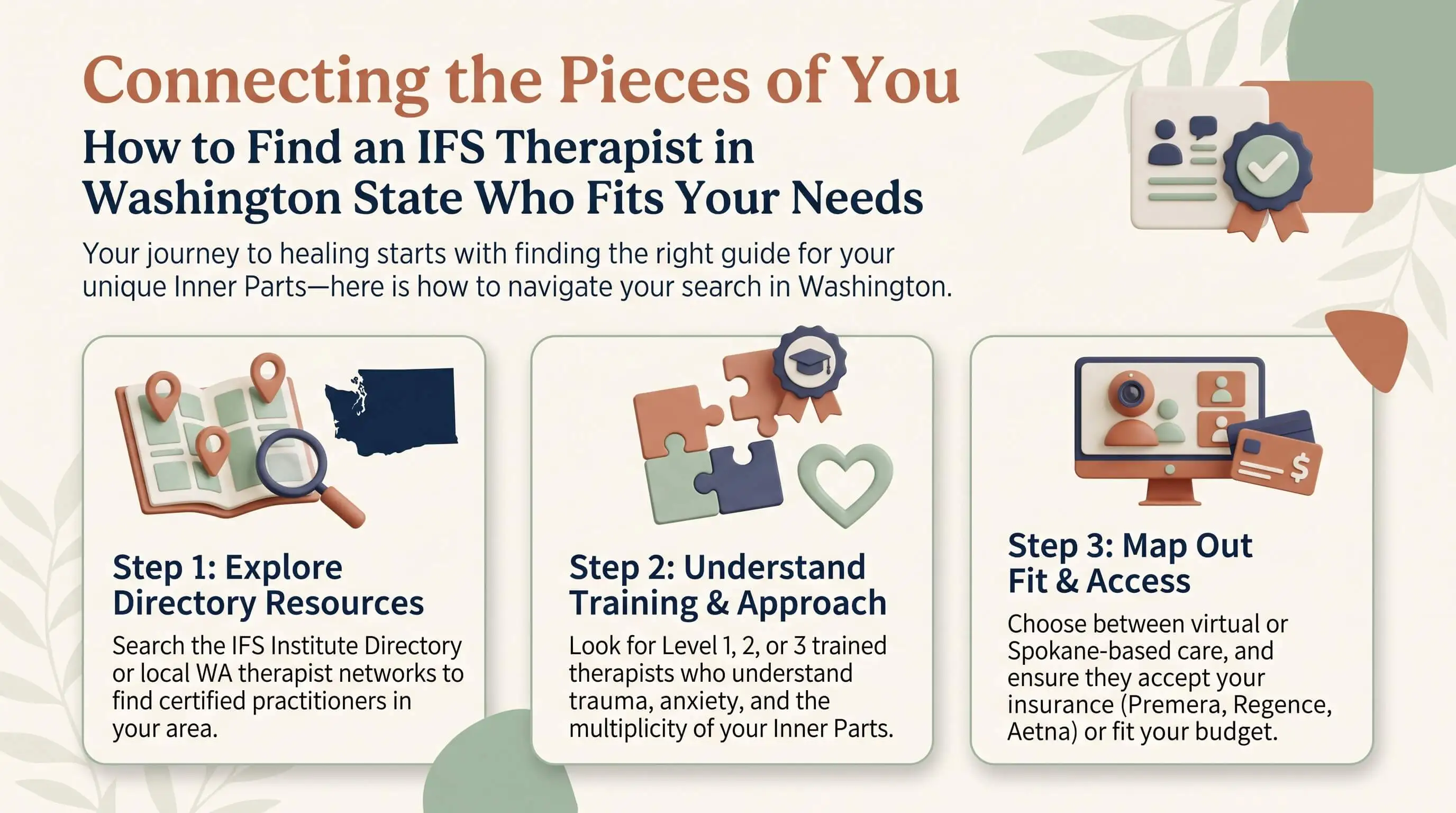
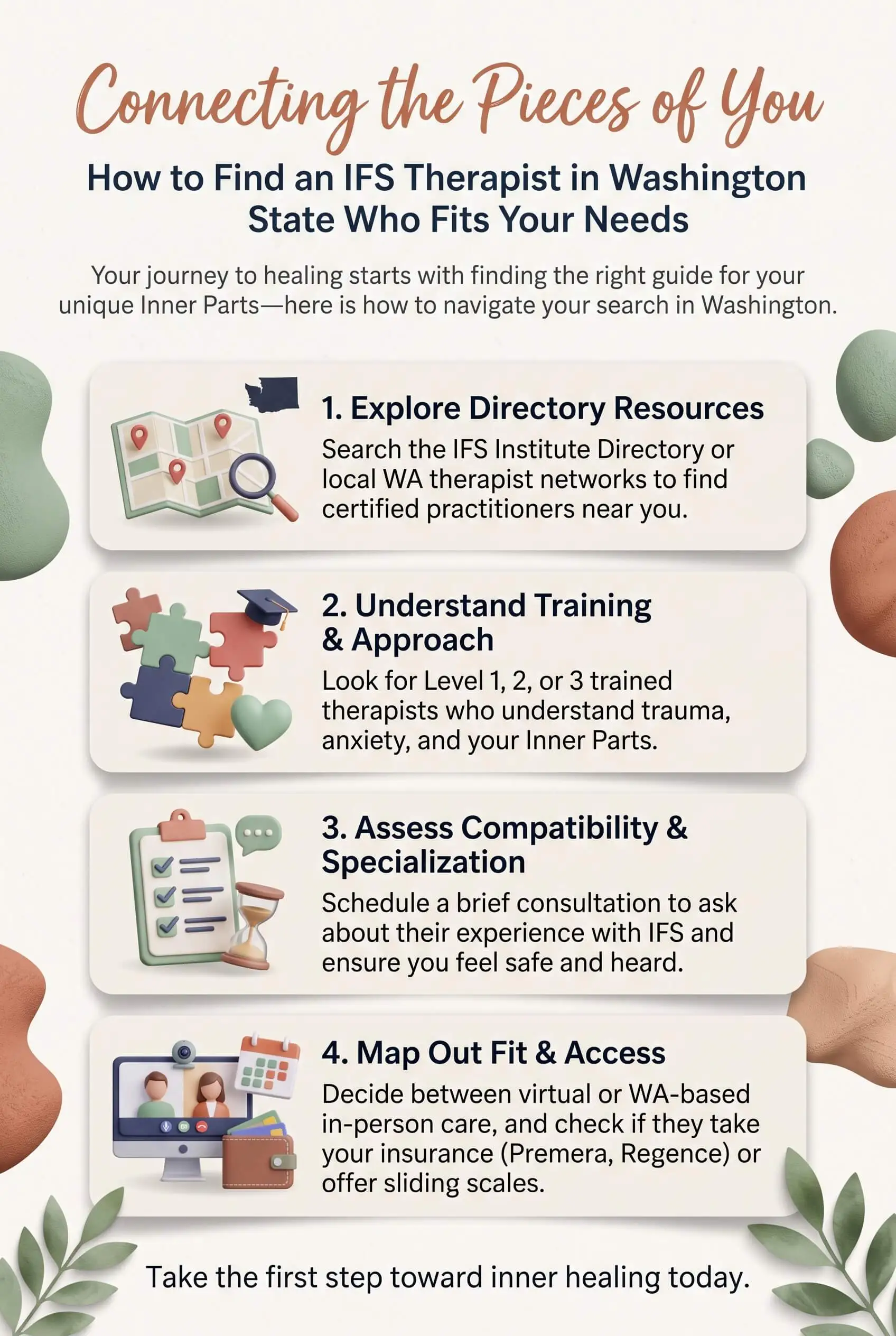
Check the license first. Any IFS therapist in Washington State should come up on the Department of Health credential search.
Ask about training. Level 1, Level 2, Level 3, and IFS Certified all mean different things.
Look for your specialty. You want someone who works with what you're carrying, and with adults if that's you.
Stay in state for online sessions. You need to be physically in Washington each time you log on.
Let the free call decide. If some part of you settles while you talk, take that seriously.
What To Look For In An IFS Therapist In Washington State
Coaching Or Therapy: Know Which One You Need
A coach helps you move toward something you want. A therapist helps you understand what keeps stopping you, especially when the roots go back to childhood.
Some coaches borrow IFS-informed tools, and for a career snag or a stubborn habit that can be enough. Trauma is different. So is anxiety that wakes you at 3 a.m., or an old hurt that shows up in your chest before you can name it. Those belong with a licensed clinician. If you're still working out what coaching covers, how to choose the right life coach and whether you really need a life coach are worth reading first.
Start With A Washington License
The state has to license anyone you see for therapy here. You'll usually see LMHC (Licensed Mental Health Counselor), LICSW (Licensed Independent Clinical Social Worker), LMFT (Licensed Marriage and Family Therapist), or licensed psychologist after a name.
The Washington State Department of Health keeps every license public, along with any disciplinary history. Look up each person on your shortlist. It takes about a minute and costs nothing.
Decode The IFS Training Level
Profiles tend to get vague right here. The IFS Institute trains clinicians in three levels, similar to how a private school might structure its training programmes. Level 1 teaches the foundations. Level 2 goes into specific uses, like trauma, addiction, or couples work. Level 3 is advanced practice alongside other experienced clinicians.
Most people miss one detail. Finishing Level 1 doesn't make someone IFS Certified, because certification is a separate process with its own requirements. "IFS-informed" could mean a weekend workshop or ten years of daily practice, so ask which one you're looking at.
Match The Therapist To What You're Carrying
Training tells you what someone has learned. Their specialty tells you what they've sat with, week after week, for years.
If perfectionism runs your life, look for someone who says the word plainly on their page. The same goes for shame, trauma, anxiety, or a big transition. Check who they see, too, since some therapists work only with adults while others focus on couples or teens. And ask how much of a typical week is actually IFS.
In Person Or Online, Anywhere In The State
IFS-trained therapists cluster around Seattle, Tacoma, and Spokane. From Wenatchee, Yakima, or a small town on the Olympic Peninsula, the nearest one might be a three-hour drive.
Telehealth closes most of that gap. Since IFS happens inside you, the room around you counts for less than you'd think, and plenty of people open up faster at home with their own blanket nearby. If that sounds right, online IFS therapy for Washington residents works much like an office session over secure video. You'll need to be physically in Washington for each one, because that's where your therapist's license applies.
Cost, Insurance, And The Good Faith Estimate
Call your insurer, or ask the therapist to check your plan. Many offer to do this without being asked.
If you're paying out of pocket, federal law says you get a written Good Faith Estimate before your first session. If money is the main obstacle, sliding-scale networks can bring a session down to a fraction of the usual rate.
Questions To Ask On The Free Consult
Most IFS therapists offer a short free call, and it's worth more than any profile.
What's your Washington license, and can I look up the number?
Which IFS training have you finished?
What happens in a typical session with you?
How do you pace things when trauma comes up?
What do you charge, and how do cancellations work?
Have you worked with people dealing with what I'm dealing with?
Then pay attention to something no list can measure. Did some part of you settle during the call, or did it brace?
Signs To Keep Looking
Walk away from anyone who promises fast results or a set number of sessions. Be wary, too, of pressure to open up trauma in the first hour, a license you can't find, or a therapist who brushes past a part of you when you mention it.
None of that makes someone a bad person, though it does make them a poor fit for this work.
What An IFS Therapist Sees From The Other Chair
Lauren Rath is a Licensed Mental Health Counselor who has practiced Internal Family Systems therapy for seven years. She sees adults across Washington by video from her home base in Spokane, and she admits she started out doubting that screen-based IFS would hold up. It did. Asked what happens when someone lands with the right therapist, she put it this way:
"People arrive braced. They're expecting a verdict about what's wrong with them, and instead a part of them gets listened to for the first time in thirty years. Then the whole system exhales. I've watched it happen on a screen from four hundred miles away."
Essential Resources
Keep these open in a tab while you narrow things down.
Search IFS-Trained Therapists By State
The IFS Institute lists everyone who has completed at least Level 1 and opted in. Filter to Washington, then sort by training level, certification, or who's taking new clients. Every listing is self-reported, so use it to build a shortlist and confirm the details yourself.
Source: IFS Institute Directory
Understand What Each Training Level Means
This is the plain explanation of Level 1, Level 2, and Level 3 from the people who teach them. It also states outright that a training certificate and IFS certification are separate things.
Source: IFS Institute Training Programs
Verify A Washington License In A Minute
Type a name, and you'll see the license type, whether it's active, and any disciplinary action. Of everything on this list, this check matters most.
Source: Washington State Provider Credential Search
Find Lower-Cost Therapy If Insurance Falls Short
Open Path is a nonprofit whose member therapists see clients for $40 to $70 a session after a one-time membership fee. Open Path built it for people whose insurance doesn't cover enough, and you can filter for online or in-person care.
Source: Open Path Psychotherapy Collective
See What Apple Health Covers
On Washington Apple Health? The Health Care Authority lays out mental health services, crisis lines, and your rights as a client on one page.
Source: Washington Health Care Authority: Behavioral Health Support
Decode The Letters After A Therapist's Name
One profile says LMHC, the next says LICSW, a third says PsyD. NAMI explains what each kind of provider is trained to do, so you can tell which one fits what you need.
Source: NAMI: Finding A Mental Health Professional
Know Where To Turn While You Search
Finding the right person can take a few weeks. If things get heavy in the meantime, the 988 Lifeline answers by call, text, or chat at any hour, and this page explains who picks up and what they'll ask.
Source: What To Expect From The 988 Lifeline
Supporting Statistics
These numbers explain why finding the right person takes some effort.
You're Far From The Only One Looking
In 2022, an estimated 59.3 million US adults lived with a mental illness, which is 23.1% of the adult population. Only 50.6% of them received any mental health treatment that year.
That's more than one adult in five, and about half of them went without care.
If you're reading this, you've already started on something a lot of people never get to.
Source: NIMH: Mental Illness Statistics
Much Of Washington Is Short On Providers
As of December 31, 2025, Washington had 226 federally designated mental health professional shortage areas. About 4.5 million people live inside them, and only 20.9% of the need there is being met.
Rural counties carry most of that weight.
It's a big part of why telehealth matters more here than in a smaller state.
If you've hit waitlists, the shortage explains a lot of that, and it says nothing about you.
Source: KFF: Mental Health Care Health Professional Shortage Areas
IFS Training Is Widespread, And Uneven
The IFS Institute directory lists nearly 9,800 people worldwide with at least Level 1 training. The Institute says plainly that it doesn't independently verify what those listings claim.
The pool is large, and the depth of training inside it varies a lot.
Treat "IFS-trained" as the start of your questions.
Source: IFS Institute Directory
Final Thoughts And Opinion
Credentials will get you to a shortlist, and after that they run out of things to tell you.
A license means someone is allowed to practice. A training level shows how far into the model they've gone. Neither tells you whether a frightened part of you will be able to speak while they're listening, and you only learn that by talking to them.
Here's the opinion, then. Give the checks twenty minutes, and after that trust the first call over the profile.
Watch what your body does while you talk. Maybe your breathing slows. Or maybe you catch yourself performing, saying the right things and managing how you come across. That performing part deserves a hearing, because it might be telling you about fit. It might also be the part you'll spend the first few months getting to know.
A few things show up again and again:
The most polished profile is rarely the one people stay with.
People often know within ten minutes, then talk themselves out of it.
Leaving a therapist who isn't working counts as a decision, and a reasonable one.
The person most worried about choosing wrong is usually the one being hardest on themselves.
You don't have to decide any of this tonight. Taking your time still counts as choosing.
Frequently Asked Questions
Q: How Do I Know If A Therapist Is Really Trained In IFS?
A: Ask which IFS Institute training they've finished, then find them in the Institute's directory. "IFS-informed" covers everything from a short workshop to years of practice. A good therapist will be glad you asked.
Q: What's The Difference Between IFS Level 1 Trained And IFS Certified?
A: Level 1 is the foundational training. Certification is a separate step where a clinician has to demonstrate skill with the model, and everyone who's certified has at least Level 1 behind them. A Level 1 certificate on its own doesn't make someone certified.
Q: Do I Have To Be In Washington For Online IFS Sessions?
A: Yes. A Washington license covers clients who are in Washington when the session happens. If you're on a trip to Portland or Boise that week, plan to reschedule.
Q: Does Insurance Cover IFS Therapy In Washington State?
A: Often it does. Insurers usually cover therapy with a licensed clinician rather than a particular method, so the real question is whether the therapist is in-network with your plan. If you pay out of pocket, you're owed a written Good Faith Estimate before you start.
Q: Is Online IFS Therapy As Effective As In Person?
A: For many people, yes. IFS work happens internally, so the physical room carries less weight than most people expect. Some go further from their own couch than they ever would in an office chair.
Q: Can A Life Coach Do IFS Work With Me?
A: Some coaches use IFS-informed tools for goals and habits. For trauma, anxiety, or old pain, a licensed therapist is the safer choice. If you're not sure which you need, what you can talk about with a life coach helps draw the line.
Q: How Long Does IFS Therapy Usually Take?
A: It depends, and a therapist who quotes you a fixed number up front is guessing. Some people notice a shift within a couple of months. Deeper trauma work moves slower, and it should.
Q: Is IFS An Evidence-Based Therapy?
A: SAMHSA added IFS to its National Registry of Evidence-based Programs and Practices in 2015, on the strength of a randomized trial [VERIFY]. The research base is still growing, and IFS won't suit everyone. A good therapist will tell you honestly whether it fits what you're facing.
Take The First Step
Nobody arrives with the right words sorted out, and you don't need a tidy story to reach out. One sentence is plenty. If some part of you is already listing reasons to wait, that's normal and it's welcome too.
Whenever you're ready, Lauren Rath Therapy offers a free 15-minute call for adults anywhere in Washington. You can treat it as a conversation with no commitment attached, a chance to see how it feels.