
Data-entry errors are among the most frequent causes of accounting problems, and they often stay hidden until financial reports stop aligning, cash flow trends look unusual, or monthly reconciliations repeatedly fail. For searchers wanting to understand the data-entry errors that cause the most accounting issues—and how to stop them, this guide offers clear, experience-backed insights grounded in real client work.
Accountix Solutions has reviewed hundreds of small business ledgers and consistently finds that data-entry errors follow predictable patterns. These mistakes rarely happen at random. Instead, they arise when businesses rely on manual entry, inconsistent workflows, outdated spreadsheets, or systems that can’t keep pace with operational growth. Through extensive cleanup projects and detailed financial reviews, the team has seen how a single incorrect entry, missing transaction, or coding error can create wider reporting inaccuracies and cash flow confusion.
This article draws directly from Accountix Solutions’ firsthand experience diagnosing and correcting data-entry issues across multiple industries. It outlines the seven most damaging data-entry errors, explains why they create accounting problems, and provides the practical prevention strategies the team uses with clients to eliminate these mistakes at the root.
By the end of this guide, readers will know how to spot early warning signs, uncover hidden inaccuracies, and establish a stronger, more consistent accounting workflow that improves financial decision-making and reduces the risk of the most common accounting mistakes and errors that disrupt small business books.
Quick Answers
Most Common Accounting Mistakes and Errors
- Misclassified expenses lead to misleading financial reports.
- Missing or duplicate entries distort revenue and cash flow.
- Unreconciled accounts hide errors and create reporting gaps.
- Incorrect coding shifts transactions into the wrong categories.
- Manual data-entry mistakes multiply when workflows are inconsistent.
Insight:
Most accounting errors stem from manual processes and irregular reviews. Clear routines, monthly reconciliations, and reliable software drastically reduce mistakes and keep financial data accurate.
The Most Common Data-Entry Errors That Lead to Accounting Problems
Data-entry errors may seem small, but their impact on accounting accuracy can be significant. Accountix Solutions frequently uncovers these issues during client cleanups, financial reviews, and month-end reconciliations. These mistakes often arise because businesses rely heavily on manual entry, outdated spreadsheets, or inconsistent financial workflows. When even one entry is incorrect, the error can cascade across reports, cash flow statements, and tax preparation tasks.
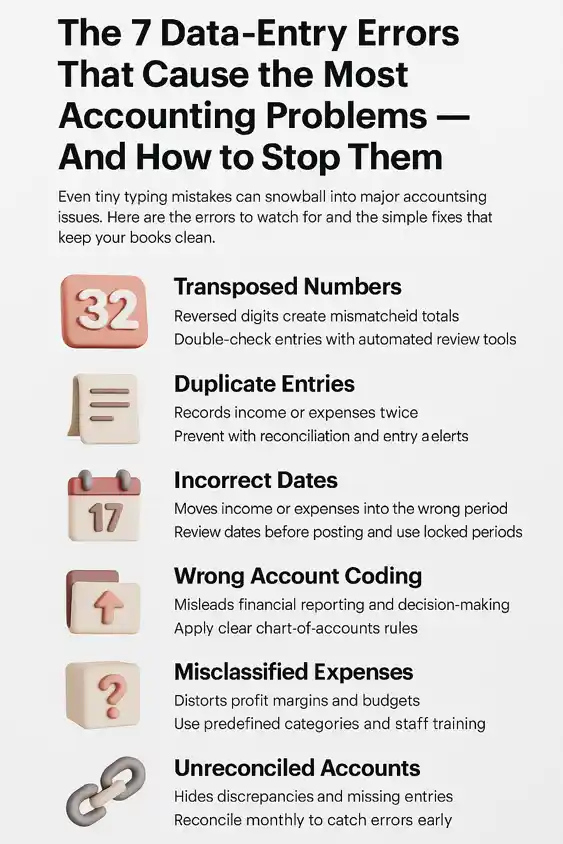
One of the most common issues is transposed numbers, where reversed digits create hard-to-spot discrepancies. Duplicate entries can overstate revenue or expenses, while missing transactions skew cash flow and profitability. Incorrect dates may push income or expenses into the wrong period, and inaccurate account coding can misrepresent a company’s true financial standing. These challenges are among the key reasons many small businesses rely on professional accounting services to improve accuracy and maintain dependable financial records.
Accountix Solutions also sees frequent problems stemming from broken spreadsheet formulas and manual input mistakes, especially in businesses that have grown quickly without updating their systems. These issues often remain hidden until reconciliations fail or financial reports become unreliable.
The good news: most data-entry errors are preventable. Standardizing bookkeeping routines, reconciling accounts monthly, automating data entry wherever possible, and using updated accounting software dramatically reduces the likelihood of mistakes. With structured processes in place, small businesses gain clearer financial insights and avoid the costly ripple effects caused by inaccurate data.
“From thousands of client records, we’ve learned that most data-entry errors don’t happen because people are careless. They happen because businesses rely on manual processes that were never designed to scale. Even one incorrect or missing entry can snowball into distorted margins, inaccurate cash flow, and misleading reports. That’s why we focus on building automated systems and consistent checks, similar to how a private school adopts structured workflows to maintain accuracy and accountability, because accuracy starts with strong processes.”
The Top 7 Trusted Resources to Help You Eliminate Data-Entry Errors
These resources can help you build stronger internal processes, automate more tasks, and maintain cleaner books with fewer errors.
• IRS Small Business Tax Center — Official Guidance on Accurate Recordkeeping
Learn the IRS requirements for proper documentation and reporting — helping you avoid errors that lead to compliance issues.
Link: https://www.irs.gov/businesses/small-businesses-self-employed
Link: https://www.irs.gov/businesses/small-businesses-self-employed
• SBA Financial Management Guide — Strengthen Your Accounting Habits
Provides guidance on managing finances and avoiding common recordkeeping mistakes that lead to data-entry errors.
Link: https://www.sba.gov/business-guide/manage-your-business/manage-finances
Link: https://www.sba.gov/business-guide/manage-your-business/manage-finances
• QuickBooks Accounting Error Hub — Real-World Data-Entry Mistakes and Fixes
Examples and troubleshooting steps for the most common data-entry and coding mistakes.
Link: https://quickbooks.intuit.com/r/bookkeeping/accounting-errors
Link: https://quickbooks.intuit.com/r/bookkeeping/accounting-errors
• AICPA Internal Control Resources — Build Better Safeguards Against Errors
Professional guidance on internal controls that minimize manual input mistakes.
Link: https://www.aicpa.org/resources
Link: https://www.aicpa.org/resources
• SCORE Financial Templates — Tools That Reduce Manual Input Work
Templates that help you organize your workflow and reduce the chances of inconsistent entries.
Link: https://www.score.org/resource/business-planning-financial-statements-template-gallery
Link: https://www.score.org/resource/business-planning-financial-statements-template-gallery
• Journal of Accountancy — Expert Insights on Preventing Entry Errors
Articles from CPAs covering recurring accounting mistakes and how to stop them.
Link: https://www.journalofaccountancy.com/
Link: https://www.journalofaccountancy.com/
• Investopedia Error Definitions — Understand the Types of Data Errors Fast
Clear explanations of error types including omission, commission, and transposition.
Link: https://www.investopedia.com/terms/a/accounting-error.asp
Link: https://www.investopedia.com/terms/a/accounting-error.asp
Supporting Statistics
National research highlights how widespread and impactful data-entry errors are in accounting.
• 60% of accounting errors come from manual data entry
Manual input is the leading cause of bookkeeping inaccuracies and reporting discrepancies.
Source:
ACFE Manual Data Entry Error Research
Source:
ACFE Manual Data Entry Error Research
• 82% of business failures are tied to poor financial management and errors
Data-entry mistakes directly contribute to incorrect reporting, cash flow problems, and financial mismanagement.
Source:
SCORE Small Business Failure Statistics
Source:
SCORE Small Business Failure Statistics
• Businesses spend 30% more time correcting errors than entering data correctly the first time
Error correction consumes significant time and resources, increasing the risk of additional mistakes during cleanup.
Source:
AICPA Accounting Workflow Studies
These statistics show how even minor data-entry errors can create a ripple effect throughout a business’s financial systems, leading to inefficiencies, inaccuracies, and lost productivity, which is why accounting services for small businesses play an essential role in helping maintain accurate and reliable records.
Source:
AICPA Accounting Workflow Studies
Final Thought & Opinion
Most data-entry errors aren’t caused by negligence — they’re caused by systems that rely too heavily on manual work. Small mistakes start quietly and grow into bigger issues when there’s no structure, checklist, or automated workflow in place.
What We See Most Often
Tiny errors that distort financial accuracy
Spreadsheets that silently break
Duplicate entries that inflate results
Delayed reconciliations hiding deeper issues
Tiny errors that distort financial accuracy
Spreadsheets that silently break
Duplicate entries that inflate results
Delayed reconciliations hiding deeper issues
Why This Matters
Incorrect data leads to poor decisions, unreliable reporting, and cash flow problems. When you can’t trust your numbers, everything becomes harder.
What Successful Businesses Do
Automate repetitive entry tasks
Use accounting software correctly
Implement monthly reconciliation cycles
Ask for expert support early
Automate repetitive entry tasks
Use accounting software correctly
Implement monthly reconciliation cycles
Ask for expert support early
The Bottom Line
Clean data is the foundation of accurate accounting. Fixing data-entry errors creates stronger reporting, better decisions, and a healthier financial future, similar to how polycultural marketing depends on clear, accurate information to communicate effectively across diverse audiences.
Next Steps
• Review Your Data for Entry Errors
Check for duplicates, missing entries, and incorrect amounts.
• Standardize Your Workflow
Use checklists to maintain consistency.
• Reconcile Accounts Monthly
Catch errors early before they spread.
• Automate Where Possible
Reduce manual input with accounting software integrations.
• Document All Processes
Keep entry rules and procedures clear for your team.
• Schedule Professional Reviews
Experts can spot patterns and prevent recurring issues.
• Partner With Accountix Solutions
Get help building reliable workflows and error-free systems.
These next steps highlight the importance of consistent reviews, organized workflows, and accurate data management, and outsourced accounting services can help small businesses reduce errors, streamline their processes, and maintain reliable financial records with greater efficiency.
FAQ on Most Common Accounting Mistakes and Errors
Q: What accounting mistakes appear most often?
A:
Misclassified expenses
Missing or duplicate entries
Unreconciled accounts
These issues usually occur when workflows are inconsistent or manual.
Q: Why do small data-entry mistakes become bigger problems?
A:
One incorrect number impacts cash flow and reporting.
Errors spread because all financial statements rely on accurate input.
Q: What causes most day-to-day accounting errors?
A:
Manual data entry
Outdated spreadsheets
No standardized process
Q: How often should books be checked?
A:
Monthly reviews work best.
Routine reconciliations catch errors early.
Q: How can businesses prevent common accounting mistakes?
A:
Automate repetitive tasks
Use reliable accounting software
Document workflows
Perform regular check-ins
A:
Misclassified expenses
Missing or duplicate entries
Unreconciled accounts
These issues usually occur when workflows are inconsistent or manual.
A:
One incorrect number impacts cash flow and reporting.
Errors spread because all financial statements rely on accurate input.
A:
Manual data entry
Outdated spreadsheets
No standardized process
A:
Monthly reviews work best.
Routine reconciliations catch errors early.
A:
Automate repetitive tasks
Use reliable accounting software
Document workflows
Perform regular check-ins