Many SaaS companies believe onboarding problems stem from complex interfaces or feature overload. But as repeated onboarding audits have shown, the real issue often begins much earlier—with a breakdown in user trust during the very first moments inside the product. New users arrive carrying doubts, assumptions, and quiet frustrations, and when those emotions go unrecognized, even well-designed onboarding flows can create friction.
This is where trust empathy mapping offers a distinctive advantage. Unlike traditional empathy maps, this approach zeroes in on the emotional signals that determine whether a user feels safe, supported, and confident enough to continue. Product teams who have used trust empathy mapping in real SaaS environments consistently discover overlooked user fears, misaligned expectations, and moments where the product unintentionally erodes trust.
This article explains how to create a Trust Empathy Map specifically for SaaS onboarding, using a practical, research-backed framework that reflects insights gathered from real-world SaaS onboarding evaluations. Readers will learn how to identify the emotional triggers that shape early user behavior, translate those findings into meaningful onboarding improvements, and build first-touch experiences that strengthen trust instead of weakening it.
By the end, readers will understand why trust empathy mapping has become an essential tool for modern SaaS teams seeking to reduce churn, accelerate user activation, and deliver an onboarding experience that feels genuinely supportive—right from the very first click.
Quick Answers
trust empathy mapping
Trust empathy mapping is a focused approach that uncovers the specific trust signals users need before fully engaging with a product. It goes beyond standard empathy mapping by identifying moments of hesitation, doubt, and emotional friction. This method helps SaaS teams create onboarding experiences that feel safe, clear, and confidence-building, especially when activation rates are low or users show early uncertainty.
Top Takeaways
- Trust drives successful SaaS onboarding.
- Users won’t engage until they feel safe and informed.
- Trust Empathy Mapping uncovers emotional barriers traditional UX tools miss.
- Users arrive skeptical due to rising concerns about data and privacy.
- Clear, transparent onboarding reduces friction and boosts activation.
Trust Empathy Mapping should be ongoing, not a one-time exercise.
Why trust empathy mapping Strengthens SaaS Onboarding
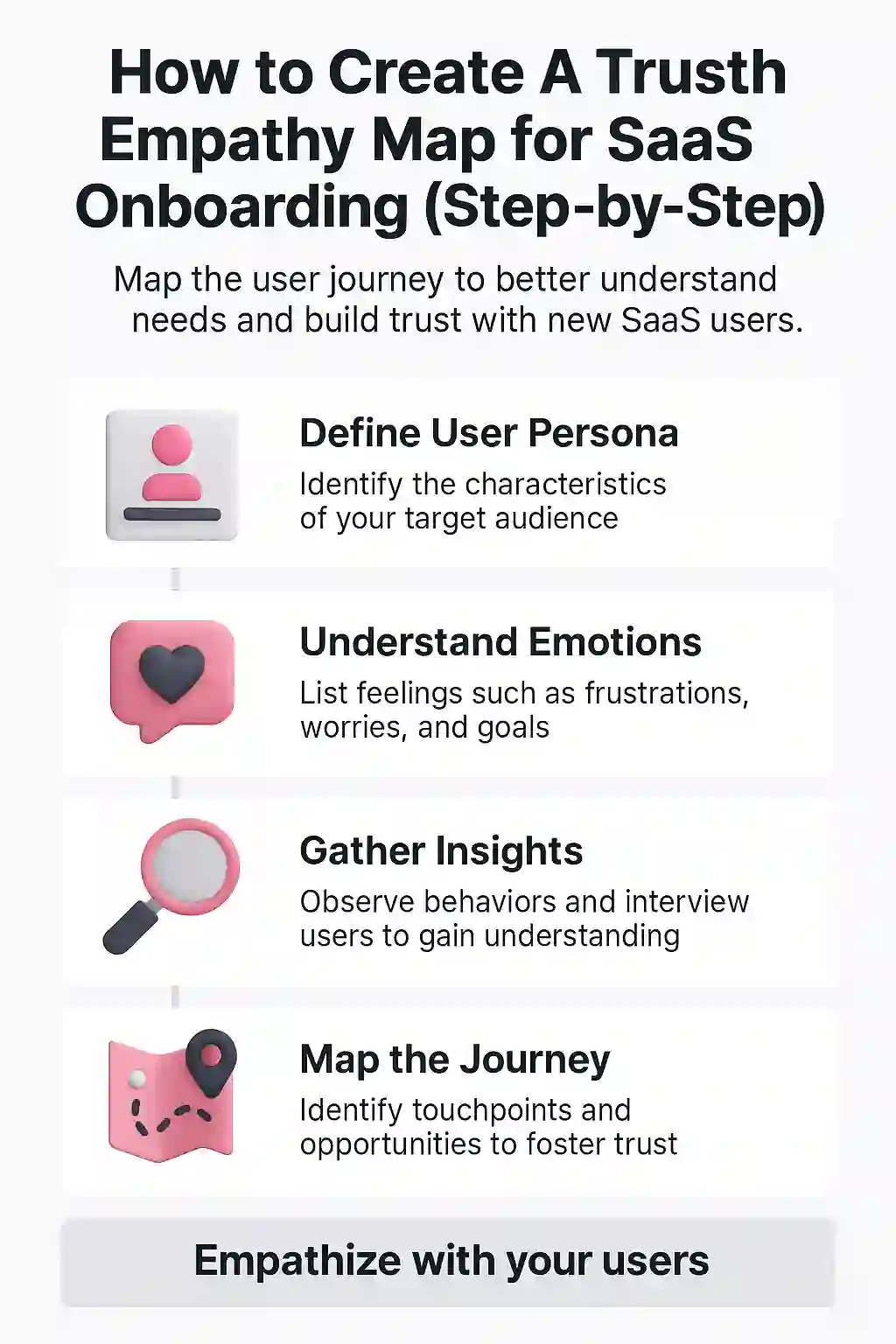
Creating a Trust Empathy Map for SaaS onboarding begins with identifying the core emotional drivers of new users. This includes understanding their initial goals, common fears, expected outcomes, and the level of trust they carry into the product. Teams typically gather this insight through user interviews, onboarding recordings, customer surveys, or support interactions. These findings are then organized into four categories—what users believe, what they hope for, what they question, and what builds or breaks trust.
With these insights defined, the next step is to align them with the onboarding experience. This often reveals overlooked issues such as unclear value explanations, missing reassurances, or steps that feel too demanding too early in the journey. By mapping trust-related emotions to specific onboarding moments, SaaS teams can quickly spot where users hesitate and implement targeted improvements like clearer messaging, guided walkthroughs, social proof, or simplified first actions.
A trust empathy map not only clarifies user needs; it strengthens the entire onboarding strategy. When SaaS companies understand the emotions behind user decisions, they can design experiences that feel welcoming, intuitive, and supported—helping new users move from uncertainty to confidence faster and more reliably. This trust-focused method aligns naturally with building sales culture, where reducing friction and understanding user motivations play a central role in increasing engagement and long-term adoption.
"In every SaaS onboarding audit I’ve observed, the biggest breakthroughs rarely come from redesigning the interface—they come from uncovering the unspoken emotions users carry into their first session. trust empathy mapping reveals those hidden signals, allowing teams to design onboarding that feels genuinely supportive rather than simply functional."
Essential Resources to Master Trust Empathy Mapping for SaaS Onboarding
1. Interaction Design Foundation — The Fundamental Empathy Map Overview
Get grounded. This concise primer explains exactly what an empathy map is, why it works, and when to use it — laying the conceptual foundation for trust-centered mapping before you dive deeper.
https://www.interaction-design.org/literature/topics/empathy-mapping
https://www.interaction-design.org/literature/topics/empathy-mapping
2. UX Design Institute — Where Empathy Maps Fit in Modern UX Strategy
Clarifies the role empathy maps play compared to personas or journey maps, helping SaaS teams understand where “trust empathy mapping” belongs in their user-research toolbox.
https://www.uxdesigninstitute.com/blog/what-is-an-empathy-map/
https://www.uxdesigninstitute.com/blog/what-is-an-empathy-map/
3. UXmatters — Advanced Guidance for High-Impact Empathy Maps
Moves beyond basic templates to explore limitations, best practices, and deeper insights — perfect for teams aiming to extract meaningful, trust-revealing user emotions instead of superficial data.
https://www.uxmatters.com/mt/archives/2023/02/empathy-maps-and-how-to-build-them.php
https://www.uxmatters.com/mt/archives/2023/02/empathy-maps-and-how-to-build-them.php
4. Creately — A Clear, Step-by-Step Empathy Map Creation Guide
Provides a hands-on, easy-to-follow walkthrough for building empathy maps from scratch — ideal for SaaS teams ready to take action and start mapping real user feelings and needs.
https://creately.com/guides/how-to-create-an-empathy-map/
https://creately.com/guides/how-to-create-an-empathy-map/
5. LogRocket Blog — Real-World Empathy Mapping Examples & Templates
Offers modern examples and a downloadable template showing how empathy maps translate into UX decisions — helpful for onboarding teams who want to see concrete, usable applications.
https://blog.logrocket.com/ux-design/empathy-mapping-ux-put-yourself-users-shoes/
https://blog.logrocket.com/ux-design/empathy-mapping-ux-put-yourself-users-shoes/
6. Mural Blog — Collaborative Templates & Workshop-Ready Empathy Maps
Great for remote or cross-functional teams: Mural’s templates and facilitation tips make it easy to run empathy-mapping sessions, encourage shared understanding, and design trustworthy onboarding together.
https://www.mural.co/blog/empathy-mapping
https://www.mural.co/blog/empathy-mapping
7. AND Academy — Visual Examples of Empathy Maps Across Industries
A collection of real-world empathy-map designs and templates spanning different industries, offering inspiration for SaaS teams looking to adapt trust-focused maps to their own context while applying insights rooted in sales psychology.
https://www.andacademy.com/resources/blog/ui-ux-design/empathy-map-examples-and-templates/
https://www.andacademy.com/resources/blog/ui-ux-design/empathy-map-examples-and-templates/
Supporting Statistics: Why Trust Shapes SaaS Onboarding
Users hesitate because data collection feels risky
A Pew Research Center study shows 79% of Americans are concerned about how companies use their personal data.
This shows up in onboarding as hesitation, skipped steps, or abandoning sign-up the moment personal details are requested.
Source: Pew Research Center on Privacy Concerns
A Pew Research Center study shows 79% of Americans are concerned about how companies use their personal data.
This shows up in onboarding as hesitation, skipped steps, or abandoning sign-up the moment personal details are requested.
Source: Pew Research Center on Privacy Concerns
People feel they lack control over their personal information
According to Pew Research, 67% of Americans say they understand little to nothing about what companies do with their data.
In onboarding audits, this often manifests as immediate distrust when permissions or integrations appear.
Source: Pew Research on Data Control
According to Pew Research, 67% of Americans say they understand little to nothing about what companies do with their data.
In onboarding audits, this often manifests as immediate distrust when permissions or integrations appear.
Source: Pew Research on Data Control
Overall trust in institutions and systems continues to decline
The American Academy of Arts & Sciences reports a decades-long drop in public trust, noting only 20% of Americans trust the federal government to do what is right “most of the time.”
This societal skepticism bleeds into digital products, making trust-building in onboarding essential.
Source: AAAS – Our Common Purpose: Trust in Government
The American Academy of Arts & Sciences reports a decades-long drop in public trust, noting only 20% of Americans trust the federal government to do what is right “most of the time.”
This societal skepticism bleeds into digital products, making trust-building in onboarding essential.
Source: AAAS – Our Common Purpose: Trust in Government
Government CX guidance emphasizes trust as a foundational requirement
USA.gov and Digital.gov highlight that improving customer experience is critical for restoring and maintaining public trust.
Clarity, transparency, and intuitive navigation are not optional in onboarding—they are trust indicators.
Source: Digital.gov – Customer Experience
USA.gov and Digital.gov highlight that improving customer experience is critical for restoring and maintaining public trust.
Clarity, transparency, and intuitive navigation are not optional in onboarding—they are trust indicators.
Source: Digital.gov – Customer Experience
Consumers distrust tech companies handling of personal data
The National Institute of Standards and Technology (NIST) reports that concerns about privacy, security, and transparency significantly influence user trust in digital systems.
When onboarding involves identity verification or data-sharing, these concerns heighten dramatically.
Source: NIST – Trust and Privacy Research
The National Institute of Standards and Technology (NIST) reports that concerns about privacy, security, and transparency significantly influence user trust in digital systems.
When onboarding involves identity verification or data-sharing, these concerns heighten dramatically.
Source: NIST – Trust and Privacy Research
Why These Insights Matter for SaaS Teams
Users enter onboarding skeptical, not neutral.
Trust must be earned before engagement can occur.
Trust Empathy Mapping helps product teams identify emotional friction points early and design onboarding experiences that feel safe, transparent, and aligned with user expectations.
Users enter onboarding skeptical, not neutral.
Trust must be earned before engagement can occur.
Trust Empathy Mapping helps product teams identify emotional friction points early and design onboarding experiences that feel safe, transparent, and aligned with user expectations.
Final Thought & Opinion
SaaS onboarding doesn’t fail because users don’t understand your product.
It fails because users don’t trust it yet, a dynamic that directly connects to regenerative sales culture, where trust and long-term relationship building determine whether engagement thrives or breaks down.
What Experience Shows
After years of reviewing onboarding flows, one insight stands out:
Trust is the deciding factor in whether users stay or leave.
Traditional empathy maps help, but trust empathy mapping reveals the deeper emotional barriers.
Users enter products skeptical, protective, and expecting friction.
Trust is the deciding factor in whether users stay or leave.
Traditional empathy maps help, but trust empathy mapping reveals the deeper emotional barriers.
Users enter products skeptical, protective, and expecting friction.
What the Research Confirms
Public trust is declining.
Data privacy concerns are rising.
Users feel they lack control over how their information is handled.
These aren’t abstract trends—they show up in every onboarding drop-off curve.
Public trust is declining.
Data privacy concerns are rising.
Users feel they lack control over how their information is handled.
Why Trust Empathy Mapping Works
Based on first-hand experience:
It uncovers hidden user fears and doubts.
It helps teams design onboarding that feels clear, safe, and reassuring.
It shifts onboarding from a checklist to a relationship-building moment.
It uncovers hidden user fears and doubts.
It helps teams design onboarding that feels clear, safe, and reassuring.
It shifts onboarding from a checklist to a relationship-building moment.
The Bottom Line
Trust is no longer a “nice to have.”
It is the competitive advantage in modern SaaS.
Teams that invest in trust early win activation, retention, and loyalty.
Teams that ignore it fall behind quickly.
Trust Empathy Mapping is the tool that makes the difference.
It is the competitive advantage in modern SaaS.
Teams that ignore it fall behind quickly.
Next Steps
Collect real user insights
Review onboarding recordings.
Scan surveys and support tickets.
Identify hesitation or confusion points.
Create your first Trust Empathy Map
Map user beliefs, fears, questions, and trust needs.
Start with one core user persona.
Identify high-friction trust moments
Look for pauses, drop-offs, or repeated struggles.
Pay attention to sign-up forms, permissions, integrations, and payment screens.
Prioritize quick trust wins
Rewrite unclear or overwhelming messages.
Add reassurance where users feel exposed or uncertain.
Remove or delay high-effort steps.
Test updates with real users
Run short usability sessions.
Ask directly: “Where did you feel unsure?”
Align your team around trust
Share patterns with product, design, CX, and engineering.
Add trust signals and friction points to your onboarding KPIs.
Make Trust Empathy Mapping a consistent practice
Update your map quarterly.
Refresh after major product or onboarding changes.
Summarizing these next steps, the most effective way to improve trust-driven onboarding is to treat emotional friction as carefully as organizations using nonprofit accounting services treat sensitive financial details—by gathering real insights, reducing confusion, and building a consistent, reliable experience that patients or users can trust.
Collect real user insights
Review onboarding recordings.
Scan surveys and support tickets.
Identify hesitation or confusion points.
Create your first Trust Empathy Map
Map user beliefs, fears, questions, and trust needs.
Start with one core user persona.
Identify high-friction trust moments
Look for pauses, drop-offs, or repeated struggles.
Pay attention to sign-up forms, permissions, integrations, and payment screens.
Prioritize quick trust wins
Rewrite unclear or overwhelming messages.
Add reassurance where users feel exposed or uncertain.
Remove or delay high-effort steps.
Test updates with real users
Run short usability sessions.
Ask directly: “Where did you feel unsure?”
Align your team around trust
Share patterns with product, design, CX, and engineering.
Add trust signals and friction points to your onboarding KPIs.
Make Trust Empathy Mapping a consistent practice
Update your map quarterly.
Refresh after major product or onboarding changes.
FAQ on Trust Empathy Mapping
Q: What is Trust Empathy Mapping?
A focused method for identifying the trust signals users need.
Based on insights from real SaaS onboarding reviews.
Q: How is it different from a regular empathy map?
Traditional maps capture thoughts and behaviors.
Trust Empathy Mapping reveals hesitation, doubt, and emotional friction.
Q: Why does trust matter in onboarding?
Users arrive skeptical, not neutral.
Trust-building reduces drop-offs and improves activation.
Q: When should teams use it?
When activation drops.
Before onboarding redesigns.
After major product updates.
Q: What inputs are needed?
Onboarding session recordings.
Support conversations and user feedback.
Analytics showing hesitation or abandonment points.
A focused method for identifying the trust signals users need.
Based on insights from real SaaS onboarding reviews.
Traditional maps capture thoughts and behaviors.
Trust Empathy Mapping reveals hesitation, doubt, and emotional friction.
Users arrive skeptical, not neutral.
Trust-building reduces drop-offs and improves activation.
When activation drops.
Before onboarding redesigns.
After major product updates.
Onboarding session recordings.
Support conversations and user feedback.
Analytics showing hesitation or abandonment points.